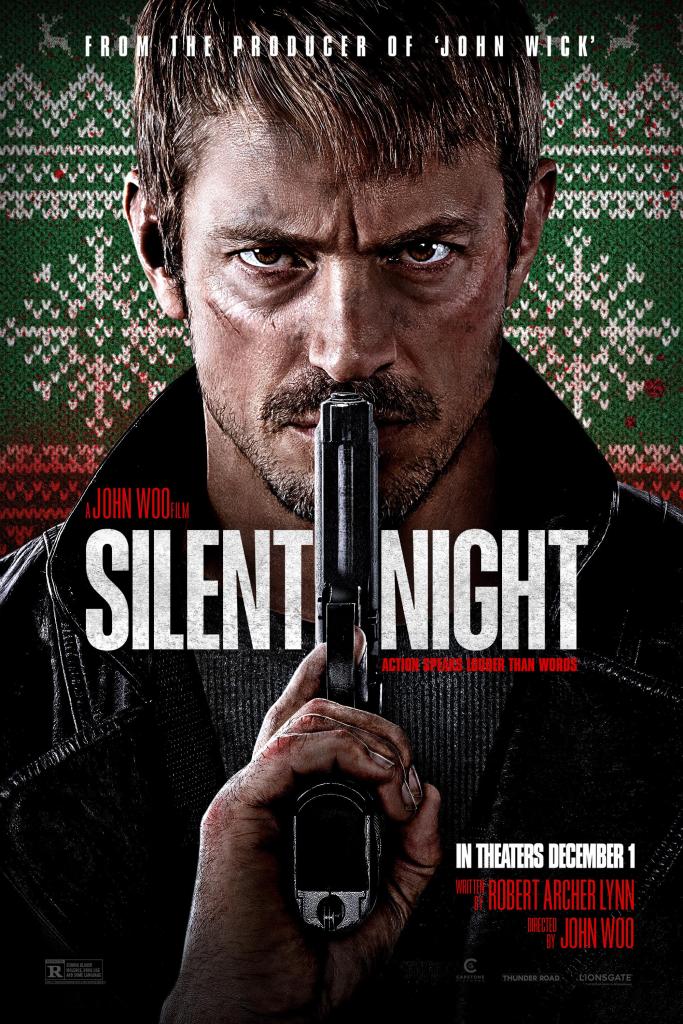
Directed by influential Hong Kong filmmaker John Woo, Silent Night finds a father, played by Joel Kinnaman, as he sets out for revenge against a gang after his son is killed. This marks John Woo’s first return to a Hollywood production since 2003’s Paycheck. On top of this, having Joel Kinnaman in the leading role of a concept surrounded by limited spoken dialogue spiked interest for many, myself included. I even had the film in my top 10 most anticipated films for the rest of the year. Even with the mixed reception, I remained hopeful, yet I walked away disappointed while still being able to recognize the film has positives.
The film starts off on a strong note with a solid action set piece. The opening credits did get a bit on my nerves as the credits kept focusing on different parts of Joel Kinnaman’s body running in slow motion as a sleigh bell around his neck was ringing. Perhaps that wasn’t the best way to present the film, but the action piece that follows suit is riveting and the best way to get the audience to know what kind of film you are getting into. You’d think this hero was a cop by his athletic abilities and dodging bullets. You’d be wrong.
From there, the film explores more of the origins of the opening sequence, which actually bothered me. The hero is shown to be an electrician who lives in what looks like a nice little town, and this is where it feels like it was written by someone who was really out of touch with reality. The hero, played by Kinnaman, shown as an electrician only really appeals to viewers who can identify as a normal person, but want more out of their life. I also had a hard time buying that not only would such a random violent scene in this town, but how would a nobody be capable of what he does in the opening scene? Since this character is just a nobody, the entirety of the first half is dedicated to a training montage that is actually well paced, but it is unfortunate when it is all said and done that not much is left of the film.
The hero, who’s name is actually Brian, is also married. This part of the storyline was not necessary at all. Not only could I not believe that this was a real marriage, but having her character took away any disbelief as to why this film needed little to no dialogue. Keeping him isolated would have been far better as we, the audience, could just focus on him. As she eventually leaves due to the stress of losing her husband, Brian could care less. Better yet, she clearly sees what he is doing to enact his revenge, yet does nothing about it. She just dips out and occasionally texts her concerns to him. To top it off, she says that Brian’s parents are also concerned. There is no importance to this matter. It just shows that he has a loving and supportive family, so for him to suddenly be violent and be quite good at it is so out of left field. It literally adds no value to him as a character and makes his journey not have any grave importance, especially when you take into consideration he waits a full year to enact his revenge. Oh, and the editing? It just results in messy camera work in other to get scenes that don’t flow as well as it likes to think it does.
As a concept, I can always get behind films that try out new things. When the film was being promoted as having no dialogue, I was excited as it would focus on Kinnaman’s acting chops and focus even more on the action. Instead, it feels like there was a film with no dialogue, but studio notes dictated that some dialogue needed to be added. We get hints of dialogue from some characters and even more through the radio, so I beg the question, what’s the point? If anything, the dialogue treats the audience as not smart enough to follow along. In one particular instance, the radio is even talking about the state of the economy. You don’t think we figured that out when you showed us the calendar countless times? At the end of the day, it just showed that this was done as an experiment more than something that could have been insightful. Hopefully it’s an experiment that good things can come out of. If this year’s No One Will Save You can do it, others can still do it, right?
Through the faults of its set up, the film still maintains promise through its action set pieces. You have to suspend some disbelief that Brian can be as good as he is when he has only trained for a year by himself. When the action hits, I thoroughly enjoyed it, even if it seemed a bit hypocritical for Brian to shoot people from his car when that’s how his son died. Other than that, the way the camera flows throughout these scenes is where the camera work and editing is at its best. You also have to suspend disbelief when he magically starts using his own motorcycle once he is done with his car. Then, there is the one-take shot in the stairway, which has to be my favorite scene of the entire film. One-take shots are my guilty pleasure, yet films still need to be able to do it effectively and this is where they get all of the technical aspects right. As Brian is walking up these stairs, he takes out bad guys here and there as the music in the background gets louder and louder as he gets higher up the stairs. I would have like to have heard the music at its normal volume, yet I found this to be something I had not seen in films before.
Scott Mescudi, otherwise known as the rapper Kid Cudi, is credited below Kinnaman in a supporting role that feels misplaced. The film would like to make you think he is vital to the story where he is only in the actual runtime for about 5 minutes. We get a nice John Wick-esque moment from Mescudi just as the one-take shot wraps up. It’s a nice touch for his presence in the film, yet his character makes no sense to me. He just now decided to take action only because Brian told him his plans? Come on. It’s lazy writing and shows that this film treats itself more like an amusement ride that seems like fun in hindsight, but somehow wastes it. Something like the Fast & Furious ride at Universal Orlando.
As the film wraps up, so many questionable things occur. For the sake of spoilers, I will keep them vague as I want to discuss how an ending like this can essentially ruin the impressive action that came before that almost saved the film. The editing continuously cuts back and forth between characters. Characters make dumb decisions for dramatic effect. Then, there is the awful scene with Brian thinking of an alternative future in a Christmas ornament. Who thought this looked okay? I guarantee they forgot this was a Christmas movie and threw that in as a reminder. Considering the film takes place in Texas and actually shot in Mexico, it’s beyond me as to why this particular setting was chosen for a “Christmas” movie.
Overall, Silent Night is a mixed back that is equal parts really good as it is really bad. When it’s really good, the action is quite exceptional and Joel Kinnaman is exceptionally good in this as he always does; however, when it’s really bad, the editing is poorly done, the redundant story conveys the wrong messages, and there are some questionable choices made within the writing. You can do a lot worse than this, but I’d only recommend this if you are a big John Woo fan, enjoy action, or seeing a different concept come to life.
VERDICT: Okay
 The Creative Cinematic Collection
You must be logged in to post a comment.