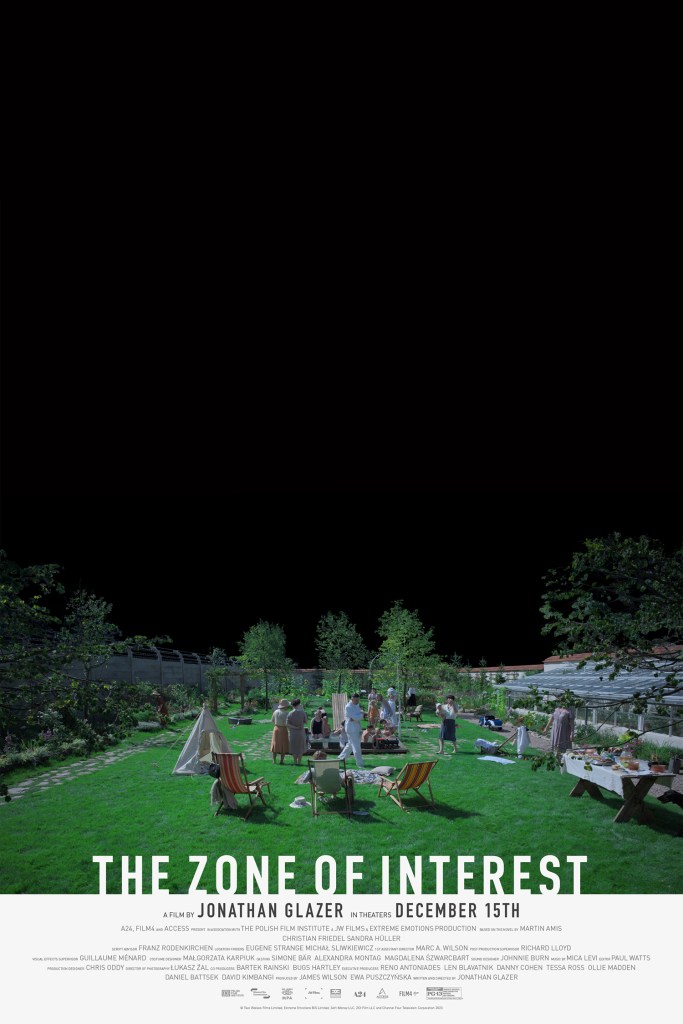
Directed by Jonathan Glazer in his first film since 2013’s Under the Skin, The Zone of Interest follows a German Nazi commandant and his wife who are building their dream live right next to the Auschwitz concertation camp. Earlier in 2023, I predicted that this film would be nominated for best picture based solely on the images and plot. To my surprise, I was correct, so my anticipation only skyrocketed from there up until I sat in the theater to watch this.
The film opens up on the title card, then slowly fades into a black screen where a musical score plays as the viewer sees nothing but black for what felt like 5 minutes. It’s a tactic that I have seen in other films that are intentional in its approach. As the film goes on, it only becomes clearer why we are introduced to the film in this manner. There’s not much music throughout the film. It’s almost entirely sound design based on how we hear the horrible things happening over on the other side of the camp, but never see. This opening mimics how we will never be introduced to the imagery that the music is conveying. The music is for those who lost their lives in the camp and is the best way to prepare the viewer to never seeing the mystery that is never shown, but we all know what it is.
It’s a tough film to get on board with as we are strictly following a family that we strongly disagree with. The film is never trying to get the viewer to sympathize with them. If anything, it feels like Jonathan Glazer wanted to bring out a story that has never been done before by showing the other perspective and getting us to understand why these people did what they did. At one point, the wife is convincing her husband, who has commands to transfer, to let the rest of them stay where they are as he leaves for work as it is what she wanted since they were 17, which is an important age that can set the tone for how adults will go on to live their lives. There is also the fact that the wife’s mother even tells her that she has truly made it while screams are heard in the distance. Once again, it’s never trying to get us to sympathize with the character, but make us understand how people can be manipulated into doing evil things, no matter what their intentions are.
Throughout the film, you get the sense that every single character has the best of intentions as this is what they are made to believe in order to survive. There is a segment towards the end of the film where the past meets the present. It’s almost like while these characters have these grand revelations alone, they are still manipulated by the public. With it’s PG-13 rating, the film is able to skip over graphic scenes, but we all know what happened, giving an extremely dumb feeling. This makes the film one of the most important films out there. I can even see this being shown to classes that will deliver some important topics. By having the past meet the present, the film begs the question: Do we go on to repeat the past or can we learn from the past and preserve the history to learn from our mistakes?
The film would never work without its two leads, Christian Friedel & Sandra Hüller. Friedel is convincing as a man who only follows the commands of others in order to survive and give his family the “dream” life. The film gives him many opportunities to turn around, but with his wife, played by Sandra Hüller, you can see where he goes further and further into darkness. Not that it his wife’s fault, but it’s the false reality they live in. Hüller is having an incredible year between this and Anatomy of a Fall – another 2023 masterpiece. I do believe between the two films, Hüller will go on to do more amazing work. As for Friedel, he is already signed on to be in the new season of The White Lotus. Giving the people who worked on the film more work is very deserving.
One of the most brilliant aspects of the film is the cinematography. While we know who these two leads are, what makes their presence unique is how it balances out with the rest of the fact and you can thank the cinematography for that. The film essentially plays out like a history book brought to live. The camera is always in one position, yet it never zooms in and out and it never physically moves. The fact that the editing can match each cut is truly astonishing. When these characters move and interact with others, it makes every other character extremely important. Since we are mostly familiar with the history of this event, it’s almost like witnessing a book of the other perspective that we are not always privy to. This can also show why it’s important to show the other perspective to allow viewers of what not to do. There were also some interest camera & editing techniques that I found interesting. Still not sure what to make of with those moments, but it makes for a good rewatching experience.
The other aspect that is certainly worth mentioning is the sound design – something that I was aware of going on, but also something that I didn’t know about because it is so vital to the overall story. With that being said, I will keep my thoughts on that as brief as possible. What’s interesting about the film is how it shows these people living in their own paradise as screams can be heard nearby. While the viewer has a good idea of what’s happening, it’s a genius way to present the film to how far gone these people are in order to fulfill their dreams. Lastly, there is this scene where someone plays something on the piano. Instead of saying the lyrics to the song out loud, the keys on the piano represent the lyrics, which are shown at the bottom like they are subtitles.
Overall, The Zone of Interest is both one of the most important films I have ever seen and one of the most haunting non-horror films I have ever seen. Showing the film from one perspective, while never showing the other, gives the viewer an idea at the other perspective behind the why of they do. The film will stay with you long after the credits roll.
VERDICT: Perfect
 The Creative Cinematic Collection
You must be logged in to post a comment.