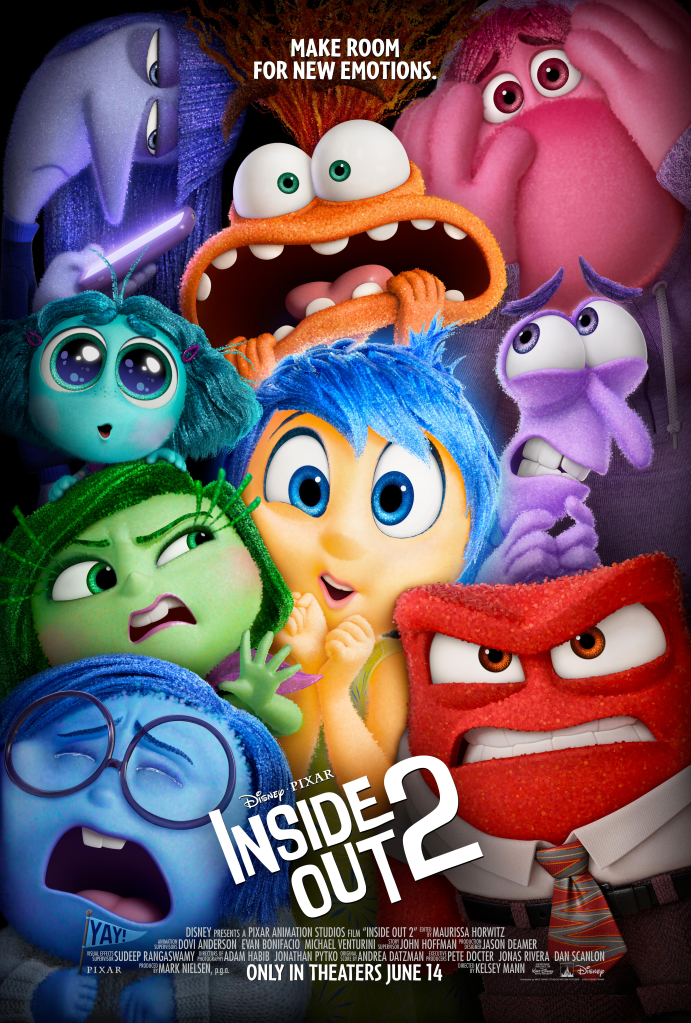
Inside Out 2 is the latest Disney Pixar movie that just hit theaters this weekend. The movie serves as a follow up to the 2015 hit, Inside Out. Kelsey Mann takes over directing duties with Amy Poehler, Phyllis Smith, Lewis Black, Diane Lane, and Kyle MacLachlan reprising their respective roles. Toly Hale & Liza Lapira replace Bill Hader as Fear & Mindy Kaling as Disgust. In new supporting roles are Maya Hawke, Ayo Edebiri, Adèle Exarchopoulos, and Paul Walter Hauser.
The newest entry picks up after the events of the first film as Riley is starting to hit puberty. Her emotions, Joy, Anger, Fear, Disgust, and Sadness all return as the little characters that display her emotions. As Riley transitions into being a teenager, new emotions – Anxiety, Envy, Ennui, and Embarrassment – began to take over, finding the original emotions in a dilemma where they must save Riley.
I can’t say that I was particularly excited for a sequel to the original. The original felt like it stood on its own, plus I am more interested in original films from Pixar more than anything. While I was watching the latest sequel, I was questioning its existence in the film’s first five minutes. It quickly catches you up to speed in order to get to its plot quicker. It made me wonder why we are getting a sequel to this, but not a proper sequel to something like Monsters, Inc. Yet, after the film’s opening minutes, the film quickly won me over and proved why this film is necessary.
As mentioned, the film’s opening minutes is a bit all over the place. The hard rock score doesn’t match the tone properly and even made me cringe a little. It relies way too much on making you remember on aspects from the original instead of just jumping right into the actual plot. In a nutshell, the beginning could have been handled a lot better. Instead, I would have preferred a slower transition into the plot like the first. The first takes its time before the title card is displayed. In this film, the title card is shown almost immediately. It might be a rather small complaint in the overall big picture. At least with the Toy Story sequels, it doesn’t rely too much on catching you up to speed, because it trusts the audience into knowing what came before.
After the film’s opening minutes, the film quickly won me over. As the plot transitions into Riley’s change into puberty is where the film gets really interesting. We see Riley as her and her friends go to hockey camp. On the way there, she learns of some news that not only upsets her, but becomes a turning point for her that sets her new emotions in play.
In Riley’s mind, the five emotions displayed in her mind from the first have all learned to coexist. Everyone has learned their lessons from the first to understand what works best for Riley, making them all feel comfortable. Right before Riley sets out for hockey camp, the emotions are thrown off when a wrecking comes through and the new emotions come in. The one new character that an integral part in the plot is Anxiety, played by Maya Hawke. When the new emotions began to take over, the older emotions get pushed out. The newer emotions, lead by Anxiety, believe they can help Riley during her transition, leading to a hostile takeover of Riley’s brain.
When you look at the overall big picture, a sequel to Inside Out is necessary. Since the first film, we, as a society, have gone through a lot. The sequel is aware of that. The film’s biggest message deals with how we coexist with anxiety. As we get older, we become more and more afraid of the future holds. When there are certain variables outside of our control, it’s easy to feel like we are spiraling out of control. We choose to live this way at times, because we want to ensure we live a happy life.
Anxiety is such a powerful emotion. Often, it can feel like anxiety is taking over and we don’t know how to get back to where we used to be. While I would say this film speaks directly to me as it tackles what it’s like to live with anxiety, I have seen where others have been saying the same thing about the film. That’s the power of Pixar. Pixar is at its best when it speaks to universal audience based on one thing that most can agree with. I found myself emotional at times throughout the film, because of how much I could relate to it. Living with anxiety can be a lonely place, and the film perfectly captures what it’s like to live with it.
What I appreciate about the film’s message about anxiety is how we have to coexist with it. It’s good to have this emotion, so the film doesn’t try to make it look like we have to eliminate it for good. Making Anxiety the antagonist was a smart move in the film, because it gives the audience an easy character to sympathize with. Maya Hawke’s voice acting for the character makes it quite easy to connect with it since we have all dealt with it. Even though it’s clear where the film is going from the beginning, it becomes so much more impactful when the film accurately displays what anxiety looks like on the outside.
As for the voice acting, Amy Poehler embodies the Joy character. The writing gives Joy the opportunity to use what she learned from the first film and use it to help her navigate this new problem. Poehler voicing Joy will probably go down as one of my favorite voice acting performances. The other standout is Ayo Edebiri as Envy. She works as a second-in-command to Anxiety, giving Edebiri the perfect opportunity to show why she is one of the best working actresses today. Then, there is the voice talent who replaces other voice talent from the first. While I would rather much prefer the original cast, I do believe there is a seamless transition with the new voice cast to still make it coherent.
Nine years after the first, and it’s clear the animation has greatly improved. Not that the animation needed improvement in the first place. At first, I was concerned the film was an excuse to display the gorgeous animation over story. It seems like that has been a common trend as of late. While the story can be predictable, the story eventually is on par with the animation and displays something meaningful to look at. The film even incorporates different animation techniques to show things more from Riley’s perspective.
Overall, It’s hard to explain much else worth noting without getting into spoiler territory. I managed to avoid a lot of the promotional material, so there are aspects of the story that surprised me. The film thrives when it doesn’t hold back from the emotional core of the story, and the animation is probably Pixar at its best. It becomes a worthy sequel that needs to be seen, but I don’t think I need to say that all that much since the film is already doing wonders at the box office.
VERDICT: Great
 The Creative Cinematic Collection
You must be logged in to post a comment.