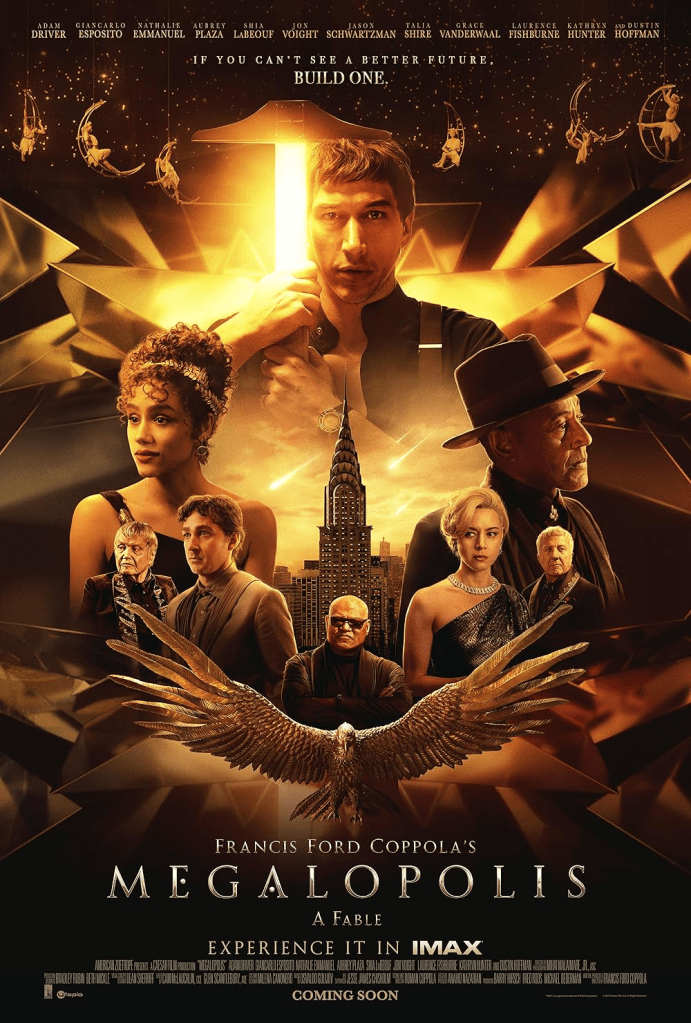
Megalopolis is the latest film from acclaimed filmmaker Francis Ford Coppola that has been in the works for about 40 years. After spending $136 million of his own money, Coppola has now unleased what may be his final movie. Set in an imagined New York City landscape, the film follows the rivalry between architect Cesar Catilina (Adam Driver) and corrupt Mayor Franklyn Cicero (Giancarlo Esposito) and how they rebuild New Rome after a devasting disaster. The ensemble supporting cast includes Nathalie Emmanuel, Aubrey Plaza, Shia LaBeouf, Jon Voight, Laurence Fishburne, Talia Shire, Jason Schwartzman, Kathryn Hunter, Grace VanderWaal, Chloe Fineman, James Remar, D.B. Sweeney, and Dustin Hoffman.
Like many other cinephiles, I have been looking forward to this for quite some time. Reflecting back on it, I couldn’t tell you what exactly excited me, because it has been an incredibly long time since Coppola came out with a movie. I think between him selling a portion of his winery to spend $120 million of his own money to fund it and the stacked cast that it injected more than enough enthusiasm into me to make me believe this would be worth watching. Even with meddling reviews and reports of toxic behavior on set, I wanted to see this through to the end. I finally got to see this in IMAX, and… it was pretty good. Not awful, but also not a masterpiece.
On top of the rivalry that this film follows, it also follows a relationship between Cesar & the mayor’s daughter, Julia Cicero (Emmanuel). I wasn’t sure how this would play out in the film. It’s clear Adam Driver is intent on working with auteur filmmakers as of lately, but Emmanuel’s filmography has been all over the place to say the least. To my surprise, I think they are both effective, especially in their relationship. The writing may not always work, but I believed the relationship and I rooted for them from start to finish.
As for Driver’s sole performance, I do believe he gave a solid performance. His character is almost Messiah-like. We never know why Cesar is able to stop time, but I think it’s more of a symbol as to his vision and his want to stop time before things get even more out of control. Many of the characters around him are either wanting to embrace the past or embrace the future, putting him in a position where the way he speaks sounds like a combination of both mindsets.
For some reason, Coppola adopted an experimental style where the on-screen talent got to improvise, resulting in Coppola consistently making changes to the script. That never made sense to me. Why would he do that for a passion project for so long? It’s no wonder the art and visual effects team resigned halfway through production. I’ll get more into that later. I want to take this one thing at a time, otherwise my thoughts are going to be as chaotic as much as the film can be. What I want to get at here is that Coppola’s style on the film results in the supporting cast not really being sure what kind of movie they are in.
Other than Driver & Emmanuel, I do believe Esposito is pretty good even if it’s the same character he has done many times before. Aubrey Plaza is also not bad. She tries to do her best with what she is given. Ironically, the two cast members that drove me nuts the most were also the same two cast members that were cast, because Coppola said they were “cancelled.” Those two actors are Shia LaBeouf & Jon Voight. The two may have had a solid career at one point, but I think after watching this, I am mentally done with them. LaBeouf is consistently acting bizarre with zero likability. He’s in a completely different film. Voight is also just there acting like he’s 30 years younger. The delivery of his dialogue is so cringey. Between those two guys and a few others who didn’t have much to do with anything (Duston Hoffman is in this… for some reason), I wish the film cut down on its cast to help develop the main story. This would have also helped bring the bloated budget down immensely.
Going back to the art & visual effects team that left, I can understand why. It’s clear how good the film looks versus how bad it looks after they left. There are some creatively unique shots thanks to the cinematography. There were a lot of other visual effects that looked cheap, and pulled out of a 2000’s movie. The art department actually did a great job here! I felt like this was something that was nearly perfected. Realistically, I wouldn’t be surprised if the Oscars tried to give the film a production & costume design nomination to help sympathize with them, because it is clear there is effort put into these technical components.
Two of the other technical components that worked for me is here with the editing and the score. Many may not appreciate how the film uses jump cuts. Personally, it never once bothered me. The film that came to mind with this was 1960’s Breathless. I saw that back in college and didn’t care much for it. Now, I am seeing the importance of watching that movie. That movie wasn’t well-received at the time due to this, and yet it seems like people enjoy it more today. Megalopolis takes almost the same approach with the way it consistently jump cuts. I was never confused with the story, but I can see where others would be confused as it misses context that is needed to help understand the story. When the film isn’t using jump cuts, the film cuts up the screen to help you understand what’s going on in different parts of the story at times. I suppose other example of this would in 2006’s Southland Tales, another film that has also been divisive.
The score embraces the film’s core messages and overall tone. I was really getting into it at one point. The film can take scores from other forms of media, but when the originality in its score is heard, you can’t help but to get into it. I do hope this will get some more recognition. You can see where there is a lot of hard-working people on this project who is trying to create something bold, unique, and unlike anything you’ve ever seen. Coppola’s writing and direction may be messy, but I don’t think the quality of the film should be hindered due to that when everyone else is trying their best and even make the film work.
As divisive as a film this going to be to many, I strongly encourage anyone and everyone who is interested in it to seek it out. It challenges the way a film is supposed to be. I can see this going on to motivate many other filmmakers to do it and maybe even do it better. I am not sure if someone like Coppola was the right pick to make such an ambitious film like this at his age. It’s clear how much he loves film with the way he utilizes arthouse techniques. Coppola’s thematic messages do hit home for me, especially in the film’s third act with messages of hope of the future.
When trying to decide what to score this, this was a challenge. Throughout most of the movie, I was teetering between a 2.5 and a 3 out of a 5. While reflecting back on my ranking for the year, I knew it was better than something than the Speak No Evil remake, but no better than something like Alien: Romulus. It’s far from perfect, but it’s also much better than what I would have thought.
Overall, Megalopolis provides enough originality in the film that makes it worth watching, even if you may think it’s bad or good. It might be the final movie from someone who tried to do something different and unique as a big-budget arthouse film. I personally love a divisive movie as they can offer something new and exciting. The film can certainly be a mess both in its writing and its visuals. I have no regrets about watching it, but I also have no desire to ever rewatch it.
VERDICT: 3.5/5 (Pretty Good)
 The Creative Cinematic Collection
You must be logged in to post a comment.