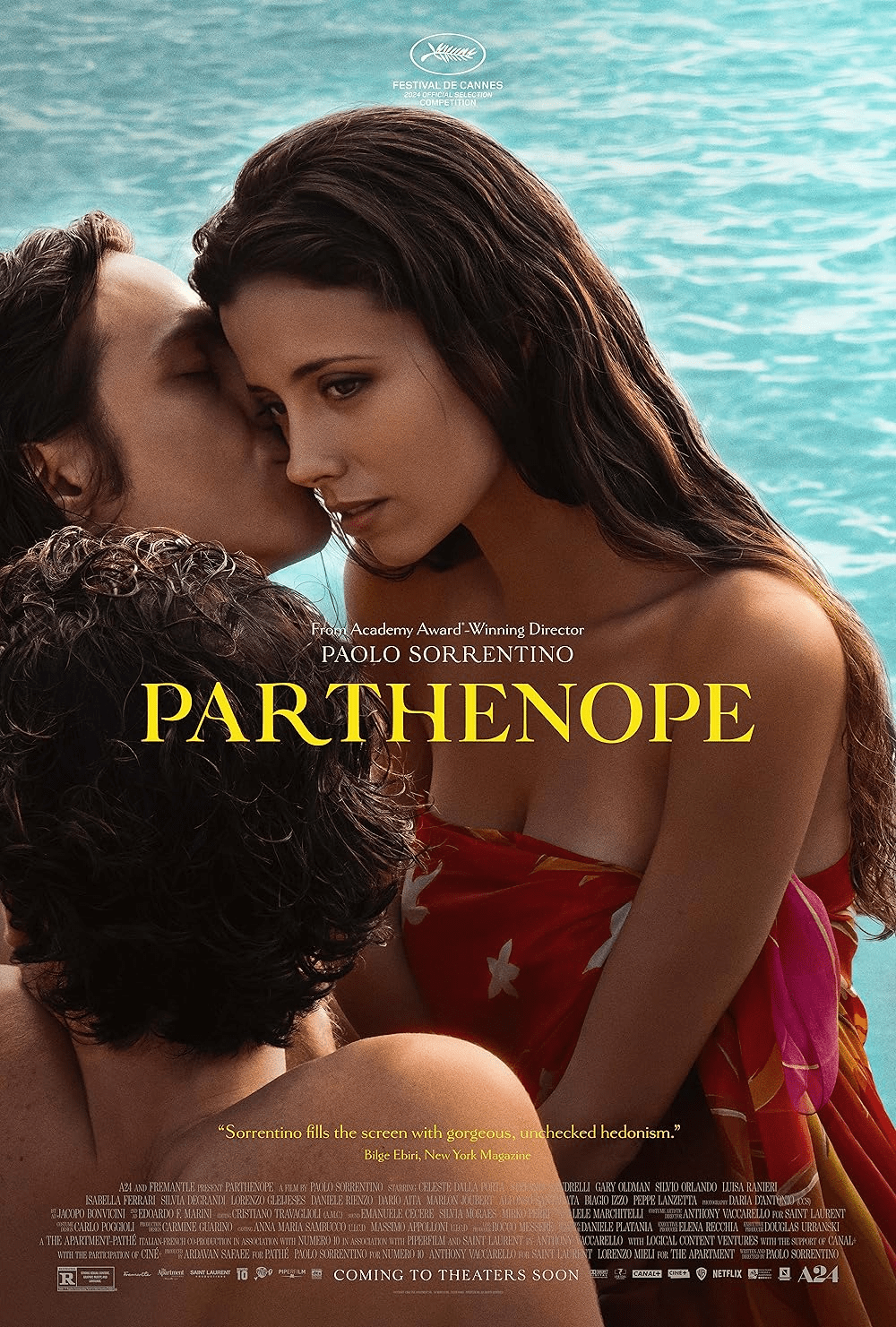
Parthenope is a coming-of-age drama that premiered at Cannes last year that released wide in the U.S. written & directed by Paolo Sorrentino, the film stars Celeste Dalla Porta, Gary Oldman, Silvio Orlando, Luisa Ranieri, Peppe Lanzetta, and Isabella Ferrari. The film follows an Italian woman, Parthenope (Porta), who searches for happiness during the long summers of her youth, falling in love with her city and its many memorable characters.
Anytime there is a new A24 film, sign me up. To see a Paolo Sorrentino film in theaters? I’m there. Given the mixed reception this film has been receiving, I went with reserved expectations. From what I had seen from photos and other marketing materials, the film looked stunning and I had a feeling Celeste Dalla Porta would be incredible. That’s exactly what I got, plus a little bit more, but I can still understand why the film is getting the mixed reception it is getting.

Right out the gage, Celeste Dalla Porta’s performance is unreal. Her character benefits on the way others tend to sexualize her without giving much thought into her feelings aside from a few people here and there. Porta is truly a star in the making. She was initially supposed to be in Sorrentino’s last film, but her scenes were cut short for some reason. It appears the filmmaker felt bad enough and built a film around her. Her performance reminds me a lot of Margot Robbie in The Wolf of Wall Street. I can easily see her career explode after this. There is also another scene-stealing performance from a famous actor that has amazing dialogue. His last line will stay with you long after he leaves the scene. It’s beautiful.
The film’s director of photography, Daria D’Antonio, won an award for her work on the film back at Cannes, and it’s well deserved. It’s rare you get a film that has stunning cinematography like this. D’Antonio manages to capture the beauty of this city that transports you to its location. You feel all the warm colors she puts on screen. She understands the kind of film Sorrentino is going for by establishing there is beauty everywhere in this city. It’s through her work that she is able to enhance what is already a somewhat inconsistent script.

I don’t want to say the script is messy at all. It’s actually quite brilliant, especially in the moments that make you think. I think the problems lie within the lack of characterization in the beginning and within how our lead character is sexualized by the male gaze and directed by a male filmmaker, but I am going to make a counterargument to that here soon. First off, the lack of characterization in the beginning is jarring. The prologue is wonderful and sets the stage for what’s to come perfectly. It’s when the film jumps years in the future that it can be hard to understand why we should care about these characters.
The film relies on having an episodic structure. That may not be for everyone. Personally, I found this approach to be captivating. It leans into how these specific moments made Parthenope into the person she is today. The film can rely a little too much on things I don’t agree with, but I believe Sorrentino is making a point with this. Parthenope’s brother is clearly in love with her, and there is even a moment when she has a fling with a priest. It can be uncomfortable, and I don’t quite agree that they were necessary, but I believe Sorrentino’s point here is how we take advantage of the beauty around us and how beauty can still come out on top. It’s a film that has a lot of heavy themes that are going to divide viewers. At the same time, I can easily see this becoming a cult classic down the line.

At 2 hour and 17 minutes, the film feels longer than it should. We spend a lot of time in these moments rather than getting the needed pieces to fill in why characters are the way they are. Had the film found a way to improve its pacing by adding in much needed context, I think the film could have flowed better. With the slow burn pacing, it’s a lot to ask viewers to be on board, especially when Sorrentino’s main objective is to have this serve as a love letter to his home country. There is awe and beauty with where he’s from, but from his perspective, it can be a huge undertaking with what he includes in this story. Based on where the film ends, many can see the resemblance with I’m Still Here in its time jump. Instead, I would have preferred more to lead up to that moment.
There’s a lot to unpack with Sorrentino’s work that I believe will have viewers appreciate the film more down the line. Given how much the character goes through, I think having a female director co-direct with those scenes would have helped show the significance of what this character goes through. I can see where Sorrentino is conveying the idea that this person represents his home country and how his country always preserved, but it is missing that emotional impact that it needs to get that point across.

Overall, there is a lot to admire in Parthenope, but there are still things that hold it back from being better. Celeste Dalla Porta turns in a stunning performance. The cinematography had me in awe in every single image. The episodic structure may be divisive amongst viewers, but I found that’s also where the film shines. The themes are questionable, yet I believe that’s Sorrentino’s intent. Even through the film’s flaws, I still enjoyed this quite a bit and found it to get better and better as time went on. By the time it reached its conclusion, I didn’t want it to end.
I will be there again for Sorrentino’s next film.
VERDICT: 3.5/5 (Pretty Good)
 The Creative Cinematic Collection
You must be logged in to post a comment.