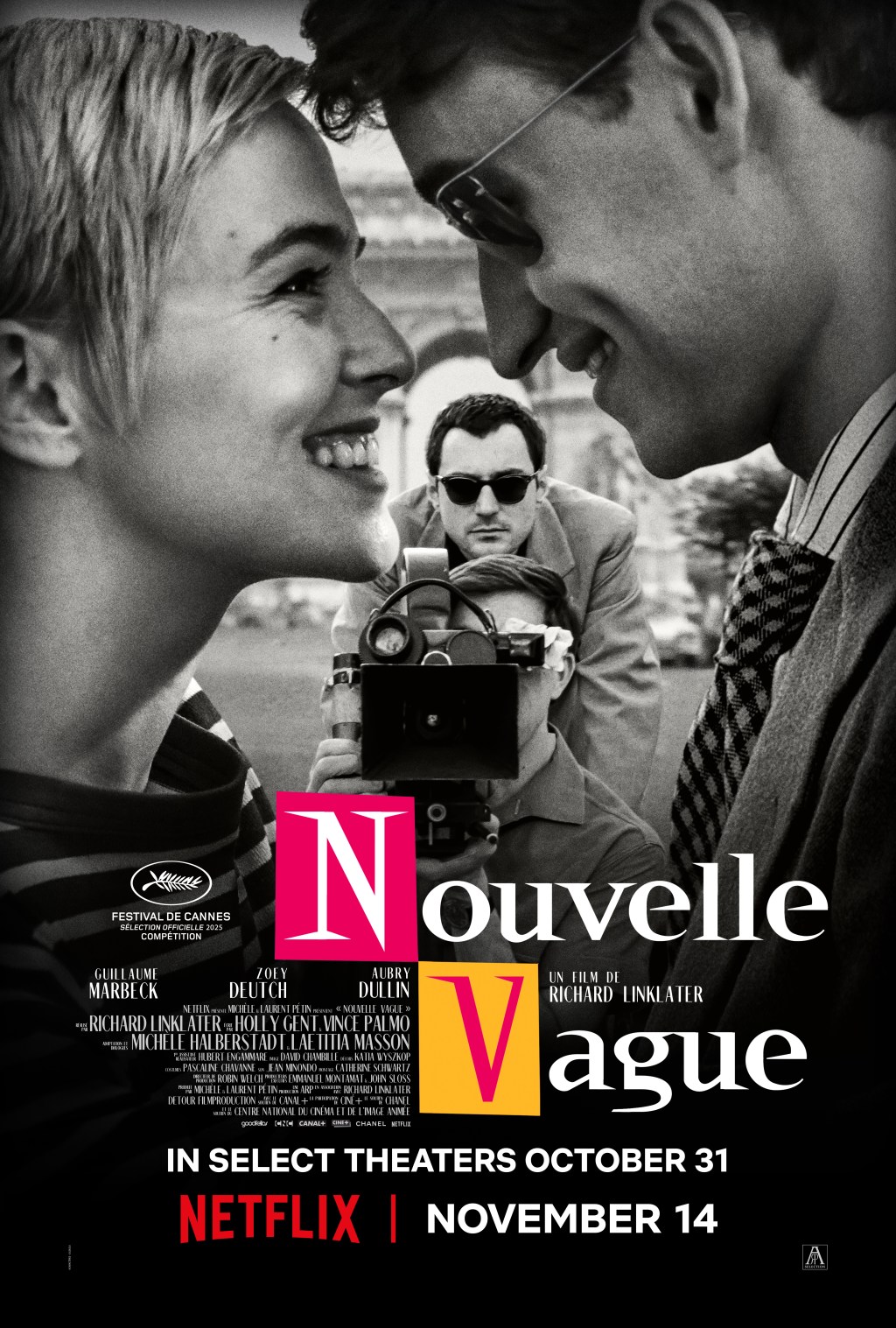
Nouvelle Vague is an upcoming film set to premiere on Netflix on November 14. Before its streaming debut, the film premiered at this year’s Cannes Film Festival and had a limited theatrical release on October 31. Written by Holly Gent and Vincent Palmo and directed by Richard Linklater, it stars Guillaume Marbeck, Zoey Deutch, and Aubry Dullin. The film follows a young Jean-Luc Godard, who, after writing for Cahiers du cinéma, decides that making films is the ultimate form of film criticism. He persuades producer Georges de Beauregard to finance a low-budget feature and collaborates with fellow New Wave filmmaker François Truffaut on a story about a gangster couple. The result is Breathless, one of the first features of the Nouvelle Vague era of French cinema.
I first saw Breathless seven years ago while in film school. Just when I thought I knew everything about cinema, Godard’s film made me realize how little I actually did. Though I didn’t particularly enjoy Breathless, I’ve always respected it for pushing the boundaries of what film could be. It’s somewhat ironic that a film about Breathless—a work that revolutionized theatrical cinema—is being released on a streaming platform. Perhaps that says something about the state of filmmaking today. Still, what drew me most to Nouvelle Vague was Richard Linklater’s involvement. He’s one of my all-time favorite directors, and his other 2025 release, Blue Moon, was fantastic. The fact that both films are coming out in the same year only reinforces just how remarkable Linklater’s range and output truly are.

The film immerses viewers in its era through its use of black-and-white cinematography and period-accurate camera and editing techniques, creating the illusion that it was shot on the same equipment used at the time. Visually, it feels as though Linklater somehow managed to capture a behind-the-scenes documentary during the actual making of Breathless. Considering the number of projects Linklater is juggling, it’s astonishing how much authentic detail he brings to this film—from the nuanced characterizations to the meticulous production design.
The first half of Nouvelle Vague is noticeably stronger than the second. It’s where the film feels most engaging and informative, offering insight into how Breathless came to be. The latter half, however, loses some momentum, feeling more like a dramatized Wikipedia summary than a continuation of the story’s deeper exploration. For those unfamiliar with Breathless, the second half may struggle to hold the same weight. Still, for cinephiles, it’s hard not to admire the precision and authenticity with which Linklater recreates this pivotal moment in film history.
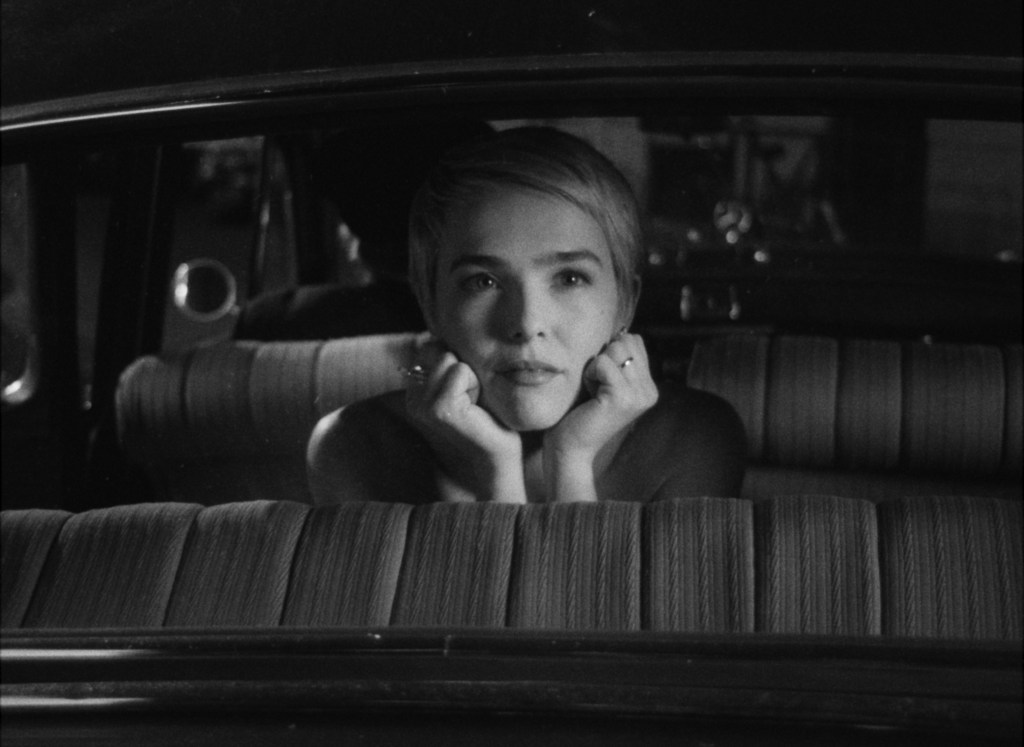
Linklater’s commitment to authenticity extends well beyond the production design—it’s evident in the performances as well. Guillaume Marbeck completely disappears into the role of Jean-Luc Godard. Given his relatively limited filmography, it’s remarkable how convincingly he embodies the iconic filmmaker’s intensity and eccentricity. Zoey Deutch continues what might be the best year of her career, delivering a performance that highlights both her range and the enduring charm that made Jean Seberg such a beloved figure. Meanwhile, Aubry Dullin, as Seberg’s on-screen partner Jean-Paul Belmondo, brings an effortless confidence and youthful energy that perfectly mirrors Belmondo’s original magnetism.
Though the film’s second act occasionally feels like a dramatized Wikipedia entry, it still provides valuable context—especially for viewers like me who didn’t initially connect with Breathless. Godard sought to make a film that looked and felt like real life, shot with the immediacy of a documentary and edited with a raw, spontaneous rhythm. Nouvelle Vague captures that spirit beautifully, embracing imperfection just as Godard did. I also appreciated how the film explores the dynamic between Seberg and Belmondo—not only highlighting their electric on-screen chemistry, but also contrasting it with the distant relationship Seberg shared with her husband at the time.

Having already seen Breathless, I couldn’t help but feel that something was missing from Nouvelle Vague’s second half. The first half offers valuable insight into who Godard was, but the film never fully explores why he was that way. While it doesn’t shy away from his flaws, it stops short of truly unpacking them. Thematically, the film may resonate most with filmmakers—those who understand the tension between artistic integrity and accessibility—but in doing so, it risks distancing the broader audience. I found myself wishing for a deeper exploration of what drove Godard to embrace his challenges so fiercely.
One of the film’s more distinctive stylistic choices is the introduction of the real-life figures involved in Breathless’s production at the start of each scene. At first, this device is clever and engaging, helping viewers situate themselves in the film’s historical context. Over time, though, the repetition begins to interrupt the pacing, pulling focus away from the narrative momentum. It might have been more effective to introduce all the key figures at the outset, allowing the story to unfold more fluidly from there.

Overall, Nouvelle Vague vividly brings the making of Breathless to life with a striking sense of authenticity, from its detailed production design to its committed performances. Linklater draws exceptional work from his central trio, each fully embodying their real-life counterparts with nuance and energy. While the film occasionally stumbles in its structure and pacing, it remains a fascinating exploration of one of cinema’s most influential movements. For cinephiles like me, it’s an engaging and rewarding experience.
VERDICT: 3.5/5 – Pretty Good
 The Creative Cinematic Collection
You must be logged in to post a comment.