
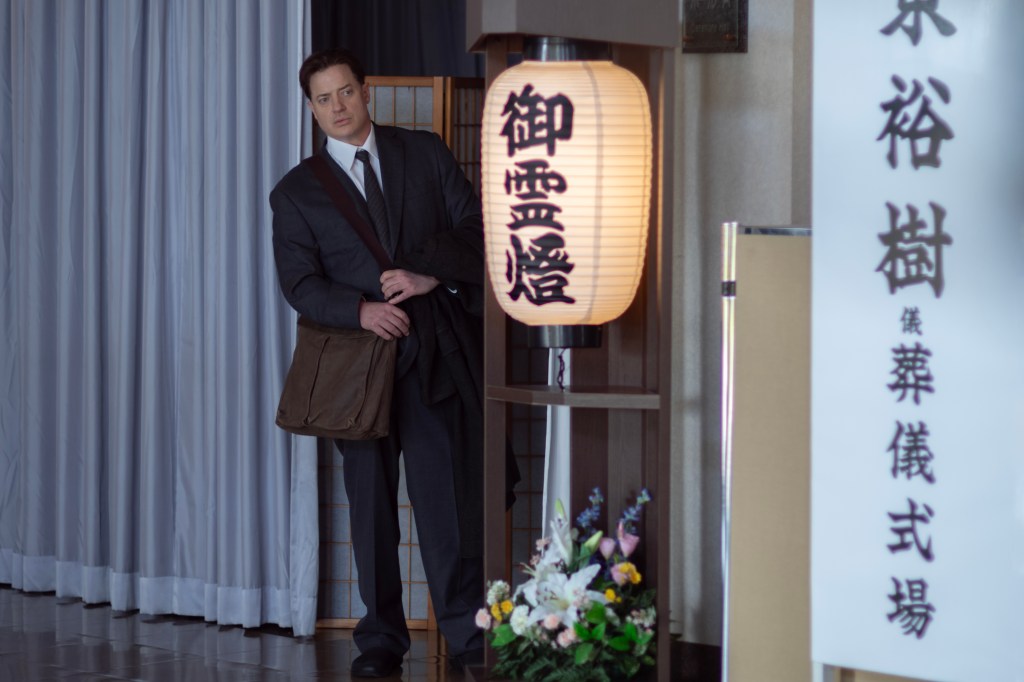
Rental Family is a new film arriving in theaters on November 21. It first premiered earlier this year at the Toronto International Film Festival. Written by Hikari and Stephen Blahut and directed by Hikari, the film stars Brendan Fraser, Takehiro Hira, Mari Yamamoto, Shannon Mahina Gorman, and Akira Emoto. The story follows an American actor in Tokyo who’s struggling to find purpose—until he lands an unusual job with a Japanese “rental family” agency, performing stand-in roles for strangers. As he immerses himself in his clients’ lives, he begins forging genuine connections that blur the line between performance and reality.
Seeing Academy Award–winner Brendan Fraser front and center in the marketing is already a strong selling point. Paired with the film’s emotionally charged, dramatic tone, it seems poised for success. The decision to release it on the same day as Wicked: For Good is curious—unless the studio is secretly hoping audiences will treat it as a quirky “Wicked Family” double feature. If that becomes a trend, you heard it here first.
Regardless, Rental Family delivers exactly what its marketing promises. It skillfully blends Western and Japanese cultural perspectives in a way that broadens its appeal. And with Fraser leading the charge, it’s hard to resist giving this film a chance.
Perfect Days isn’t just one of my favorite films—it genuinely changed my life. Although it was released only two years ago, I can already see many parallels between that film and Rental Family. Both center on male leads whose backgrounds are kept intentionally vague, yet we’re given just enough pieces to understand who they are and what drives them. Because of this, neither film relies on forced or clichéd exposition. Instead, we’re dropped straight into the story, experiencing the world through the eyes of flawed but deeply passionate human beings.
Often, when an actor wins a major award and the studio leans on it for marketing, the film itself doesn’t always measure up. But let me be clear: Brendan Fraser earned that award for a reason. We’re still feeling the full force of the “Brendaissance,” and it’s hard to imagine him delivering anything less than exceptional going forward. This film captures both his charm and his vulnerability, and his seamless transitions between English and Japanese language are nothing short of impressive. Everyone else around him also gives commendable, stand-out supporting performances.

The film explores a lot of ideas—most of which work. While we can understand and sympathize with why these characters lie, there are always complications simmering beneath the surface. Thanks to the emotional depth Fraser brings to the role, his character feels like the perfect fit for this line of work, even as he recognizes its flaws. He sees what’s broken and still tries to make life better for the people around him, which can also be read as his attempt to build the family he never had. And just when you think the film won’t fully hook you emotionally, it does—often in surprising ways.
Those surprises, though, can also serve as the film’s weaknesses. Early on, it almost feels like Fraser’s character lacks enough definition. But much like Perfect Days, the film benefits from keeping his backstory and motivations at arm’s length, allowing viewers to project themselves onto him and form a deeper connection. Still, the movie occasionally tries to juggle one storyline too many. While I enjoyed each thread individually, the film might have been even stronger had it committed to a single narrative focus.

When the film first opens, it’s easy to mistake what you’re seeing for a commercial. It’s a clever, symbolic touch that reflects the work Fraser’s character has grown accustomed to. The cinematography makes Japan look both grand and cinematic, yet the pacing and editing lend an intimate feeling—as though we’re quietly observing moments rather than simply watching them. The score is equally strong, complementing the script’s heartfelt tone without ever overwhelming it.
The script has plenty of strengths, and I suspect it will play even better on a second viewing. Still, while Japan is a vast place, there are a few moments that feel like potential plot holes—particularly regarding how the Rental Family business operates. For example, the film never fully addresses the likelihood of running into someone from the agency who is currently portraying a different role. It almost feels like the system itself would function better with a touch more honesty, a theme the film hints at but doesn’t fully explore amid everything else it’s tackling.
The story contains a number of surprises, but it got me thinking: what if this had been a miniseries? Following Fraser’s character through multiple families over several episodes could have offered something truly unique, giving the themes more room to breathe and avoiding moments that feel a bit rushed.

Overall, despite juggling a wide range of ideas, Rental Family remains a compelling film that subverts expectations and delivers genuinely hard-hitting emotion. Fraser gives a remarkable performance—one that reaffirms exactly why he’s an Oscar winner. I also love how Japanese culture is woven so naturally into the story, and I hope American audiences are drawn to it not only because of Fraser’s likability, but because the film itself is well worth seeking out.
VERDICT: 4/5 – Great
 The Creative Cinematic Collection
You must be logged in to post a comment.