
IT: Welcome to Derry is a new HBO series, with all seven episodes now available to stream and the season finale premiering tomorrow night. Created by Andy Muschietti, Barbara Muschietti, and Jason Fuchs, the show stars Taylour Paige, Jovan Adepo, Chris Chalk, James Remar, Stephen Rider, Clara Stack, Amanda Christine, Mikkal Karim-Fidler, and Bill Skarsgård. Set in 1962, the story follows a couple and their young son who move to Derry, Maine, just as a local boy goes missing. Soon after their arrival, a series of disturbing events begins to unfold throughout the town.
I was really looking forward to this show. I watched the first two IT films at just the right time for them to turn me into a fan, even if a recent rewatch reminded me that the second installment doesn’t quite hold up—and definitely doesn’t need to be as long as it is. I reached out to the team at Warner Bros., who generously granted me early access to each episode, allowing me to share spoiler-free reactions on my Instagram the day before each one premiered.
While I can understand the mixed reception the series has been getting, by the time it reaches its conclusion, IT: Welcome to Derry proves itself to be a worthwhile watch.

The first episode exceeds all expectations, delivering one of the strongest horror television premieres in recent memory. Just when you think the story is heading in a familiar direction, it completely subverts expectations—a sentiment I believe many viewers would agree with. From there, the overall quality doesn’t quite reach the same heights as the premiere, though several episodes remain strong. The show’s biggest challenge is juggling two very different storylines, which ultimately becomes its weakest element.
Although the conclusion of the first episode subverts expectations through the kid’s storyline, it remains the most compelling aspect of the season, largely due to Clara Stack’s standout performance. I went in expecting Taylour Paige to be the central figure, especially given her top billing (more on that later). Instead, a relatively unknown actress emerges as the heart and soul of the series. The first season feels satisfyingly self-contained, while still setting up the creative team’s three-season plan with an entirely new story. That makes it disappointing that we may not see Clara Stack return, as her character is deeply affecting and easy to connect with—shaped by past trauma and the ongoing horrors she’s forced to endure.

I was fully aware of the military storyline going into the series, though it was never something I fully understood or felt confident about. Even before watching, it struck me as a far-fetched concept—and coming out on the other side, that feeling hasn’t changed. While the cast assembled for this storyline is impressive, the writing rarely gives them the space to showcase their talents. The military plot often feels like an afterthought, included mainly to justify an eight-episode season. Even when the kids’ storyline and the military thread finally converge, the connection feels forced rather than organic. Although the storyline attempts to expand the broader Stephen King universe, it never becomes as interesting or compelling as it should. With someone like Taylour Paige right there, it’s especially disappointing to see how underutilized she is.
That said, the show still works overall, even with the flaws of the military storyline. Some fans may be frustrated by how long it takes for Pennywise to fully enter the picture. I was admittedly surprised by the delay, but I ultimately appreciated it. By holding Pennywise back, the series allows fear to build naturally—much like Jaws. This approach gives Bill Skarsgård the space to deliver yet another standout performance, one that adds depth and texture to the Pennywise mythology.
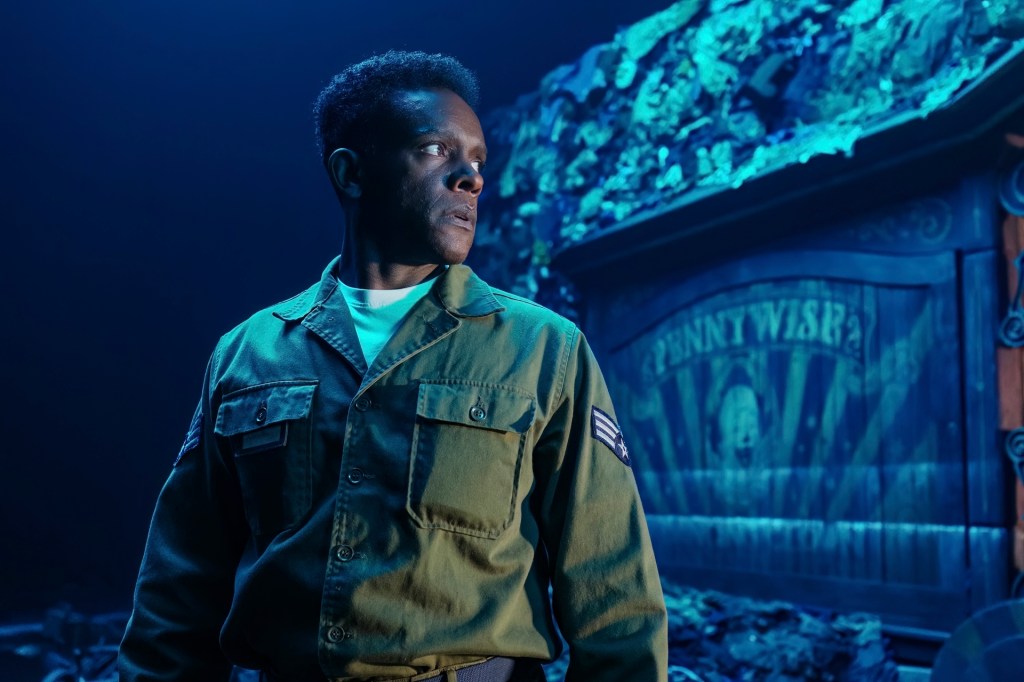
The show’s overall look is largely immersive, from the detailed production design of the town to the impressive one-take shot of the burning building in episode seven. It also features a haunting, memorable score, paired with a perfectly chosen song for the opening credits. Moments like these make it easy to remember why HBO is often synonymous with prestige television—they consistently deliver on presentation. That said, the CGI can be noticeably rough at times. Co-creator Andy Muschietti, who also directed the recent IT films, tends to rely heavily on CGI, and in horror especially, that reliance can be distracting. Practical effects would have been far more effective. The CGI often pulls you out of the experience, with the graveyard scene standing out as particularly unconvincing. Unfortunately, it doesn’t seem likely that the series will shift toward practical effects in the future, serving instead as a reminder of how much better other films and shows handle the balance between practical and digital effects.
Where the series truly excels is in its willingness to subvert expectations. The surprises come frequently and rarely let up. For the most part, the story feels carefully constructed—aside from the military storyline—but the heavy use of exposition is hard to ignore. Rather than allowing the narrative to unfold organically, characters are often forced to explain plot details and lore outright. While some exposition is inevitable in a story like this, these moments feel unnatural and make the characters harder to connect with. People simply don’t talk this way. Much like the effective glimpse into Pennywise’s backstory at the beginning of episode seven, the show would have benefited from trusting visual storytelling more. In the end, “show, don’t tell” remains the golden rule—and it applies here as well.

Overall, IT: Welcome to Derry is still a series worth exploring, even with its shortcomings. If you’re primarily eager to see Pennywise return, it may be best to wait until all eight episodes are available, as the show takes a more deliberate and creative approach to bringing him back into the story. The kids’ storyline is clearly stronger in terms of writing and emotional engagement than the military plot. While the series continues to rely heavily on CGI, it compensates with strong production design and striking cinematography. With rumors suggesting a two-year wait before a second season, I hope that time allows the creative team to refine their approach and deliver a stronger follow-up that addresses the show’s current flaws.
VERDICT: 3.5/5 – Pretty Good
 The Creative Cinematic Collection
You must be logged in to post a comment.