Wicked: For Good hits theaters November 21 as the sequel to last year’s Wicked. Written by Winnie Holzman and Dana Fox and directed by Jon M. Chu, the film stars Ariana Grande, Cynthia Erivo, Jonathan Bailey, Ethan Slater, Bowen Yang, Marissa Bode, Colman Domingo, Michelle Yeoh, and Jeff Goldblum. As an angry mob rises against the Wicked Witch, Glinda and Elphaba must come together one final time. With their unlikely friendship now the fulcrum of their futures, they’ll have to truly see one another—with honesty and empathy—if they hope to change themselves, and all of Oz, for good.
It’s been only a year since we first returned to the world of Wicked, and a lot has happened since then, but I still remember what it felt like seeing that film for the first time. What I experienced made me an instant fan—which says a lot, considering I’m not usually drawn to musicals. The world of Wicked evoked the same wonder I felt growing up with Harry Potter and The Lord of the Rings, and it’s a shame that after only a year of rediscovery, this chapter is already coming to a close. After watching the sequel, I gave myself a night to sit with it to see if my score would change. It didn’t, though I can understand why this installment is receiving more mixed reactions than the first.

In many ways, the first and second parts feel like two sides of the same coin. Where the first film is packed with energy and world-building, the second slows down and becomes more character-driven, focusing on the consequences of everyone’s actions at the end of Part One. I’m not deeply familiar with the stage musical, but from what I’ve heard, its second act is generally considered weaker than the first. That doesn’t mean this film fails to deliver a meaningful adaptation—because it absolutely does. The challenge it faces, however, is how tonally jarring it feels compared to its predecessor.
The first half of the new film is much slower than I expected—so much so that I found myself wondering whether it was dragging things out too far, or if the story really needed two films in the first place. But truthfully, there isn’t a single thing I would have cut from the first movie, and splitting the musical into two parts was still the right call. I ultimately appreciated how much the sequel lingers on where the characters are emotionally and mentally; the quieter pacing gives their journeys room to breathe. In many ways, it reminds me of Pirates of the Caribbean: At World’s End—a slower, weightier continuation that initially divided audiences but gained appreciation over time. I can see this film following a similar path.
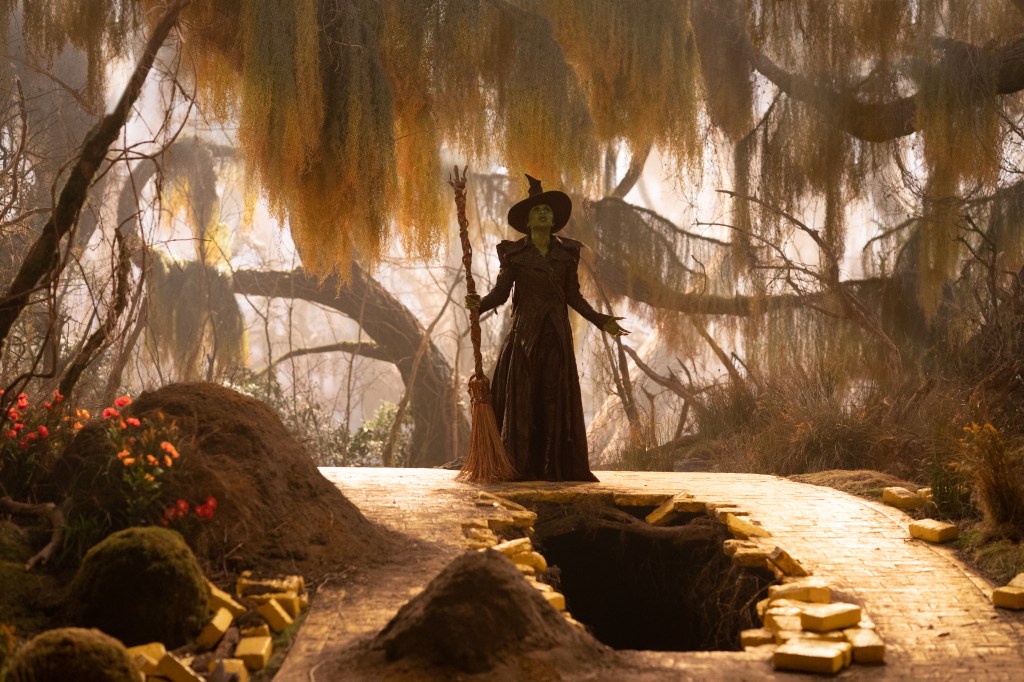
The second half of the film picks up the pace once Dorothy enters Oz. We never see her face, which works well—this story isn’t about her, and the choice avoids unnecessary comparisons to The Wizard of Oz. This installment also runs about 30 minutes shorter than the previous one. When Dorothy does arrive, the film does start to feel rushed. While that may sound like a criticism, I actually think it works in the film’s favor. The slower, more introspective first half sets the stage, and the second half shifts into the kind of excitement and momentum that keeps viewers engaged. Yes, the Dorothy subplot could have been more fleshed out, especially for those unfamiliar with The Wizard of Oz, but it still brings something fresh to the narrative—something that distinguishes this film from the first while also bringing things full circle by answering questions raised earlier.
If the first movie is told through Elphaba’s perspective, this one is unmistakably Glinda’s. We saw Elphaba as a child in the first film, and here we get the same treatment for Glinda. It’s a clever way of highlighting how both characters anchor the story, making their dual arcs feel cohesive and intertwined. As the film progresses, you can even see how their signature colors become more pronounced in their costumes, visually marking their growth on each other. Interestingly, I felt Cynthia Erivo delivered the stronger performance in the first film, while Ariana Grande shines brightest here. Grande was terrific before, but this time you can truly see her stepping into a leadership role while maintaining the quirky charm that defined her character in Part One.

As I mentioned, I’m not big on musicals. It’s the one genre I tend to be most critical of because musical numbers often pull me out of the story. But it wasn’t until the end of this film that I even had to remind myself I was watching a musical. These films simply wouldn’t work without their musical elements. While the songs in the first film matched its lighter, more playful tone, the numbers here reflect the darker, grittier atmosphere of the sequel. They still feel immersive and integral to the narrative. And, much like in the first film, the final musical number is guaranteed to stir up some strong emotions.
The sequel continues to impress with its costume design, production design, and cinematography. This time, I did notice the darker color palette—a common criticism of the first film. Even so, I think it adds a sense of realism and visually communicates how the world has changed under Oz’s leadership. The film is almost certain to earn another Academy Award nomination for Best Costume Design. The attention to detail in what each character wears not only looks stunning but also deepens their characterization. As for the cinematography, there’s a mirror shot that left me genuinely puzzled in the best way—I still have no idea how they pulled it off.

Overall, Wicked: For Good is an epic and satisfying conclusion to what came before. Its tone and pacing differ noticeably from the first film—something that may not work for everyone—but in many ways, those differences give this installment its own identity. Cynthia Erivo and Ariana Grande have brought these characters to life in iconic fashion, with Grande delivering a performance that could very well put her on the path to an Academy Award.
VERDICT: 4.5/5 – Amazing


 The Creative Cinematic Collection
You must be logged in to post a comment.