The Secret Agent had its world premiere in the main competition at the 2025 Cannes Film Festival this past May. Positioned as a serious awards contender, the film has been rolling out gradually and is expected to expand into more theaters worldwide over the next several months. Written and directed by Kleber Mendonça Filho, the film features an ensemble cast including Wagner Moura, Carlos Francisco, Tânia Maria, Robério Diógenes, Alice Carvalho, Gabriel Leone, Maria Fernanda Cândido, Hermila Guedes, Isabél Zuaa, and Udo Kier in his final screen role. Set in 1977 Recife, the story follows Marcelo, a technology expert in his early forties who returns during Carnaval to reunite with his son and plan a perilous escape under the constant surveillance of Brazil’s repressive military regime.
I first encountered Wagner Moura in Netflix’s Narcos, where his transformative performance as Pablo Escobar was so convincing that I initially worried he might be typecast. In hindsight, that assumption undersold him. Moura had already built an extensive career before Narcos, and the work he’s taken on since has only reinforced his versatility and range. If anything, Narcos simply gave him the visibility to reach a broader audience. Whether you’re drawn to The Secret Agent for Moura’s performance or the film’s widespread critical acclaim, there’s every reason to expect it won’t disappoint.

The film’s introduction immediately brought to mind the opening of Quentin Tarantino’s Inglourious Basterds. Despite not wanting to dwell on Tarantino given his recent comments, I couldn’t shake the stylistic resemblance. Though the scene unfolds mostly outdoors, it carries the focused, theatrical tension of a contained stage play. It captures both the beauty and vivid color of its setting while steadily tightening the suspense. From its quiet stillness to its unsettling undercurrent, it’s the kind of opening that pulls you in right away.
From there, the film adopts a distinctive narrative structure. At 2 hours and 38 minutes, its length is arguably its weakest point, yet the pacing allows the story and characters to deepen in meaningful ways. Instead of beginning at the very start of Marcelo’s journey, the film drops us into his return—an arrival that sets the stakes and outlines the dangers ahead. He’s a man trying to do the right thing, even as the cost of coming back grows increasingly steep. The risks, the tension, and the thoughtfully drawn supporting characters all add layers that make the extended runtime feel purposeful rather than excessive.
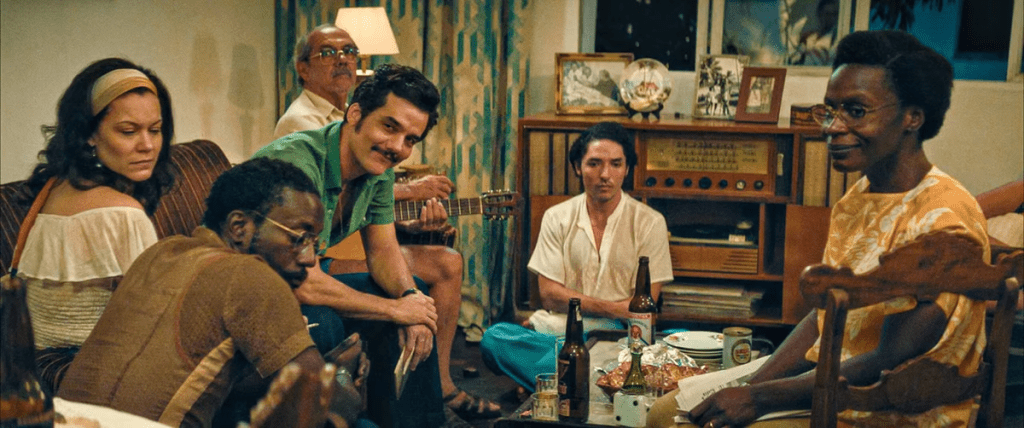
As we approach the end of 2025, don’t be surprised if Wagner Moura appears on many year-end lists for best performances—he’ll likely be on mine. Just as 2024 was a standout year for actresses, 2025 has shaped up to be exceptional for actors, making the upcoming awards race particularly unpredictable. What Moura delivers here demands immense commitment, and despite Kleber Mendonça Filho juggling a large ensemble cast, he still draws out a remarkable performance that reaffirms Moura as one of the strongest actors working today.
With the acclaim surrounding this film—and last year’s Brazilian standout I’m Still Here—it’s hard not to think back to the first time I experienced City of God. Although it was released in 2002, I didn’t see it until high school around 2010, and it became one of the reasons I’m such a devoted supporter of international cinema, especially films from Brazil. The themes in City of God, and in much of contemporary Brazilian filmmaking, remain strikingly resonant—whether reflected in current events or in lived experiences. I can easily imagine someone watching The Secret Agent for the first time and feeling the same sense of impact and discovery that City of God gave me all those years ago.
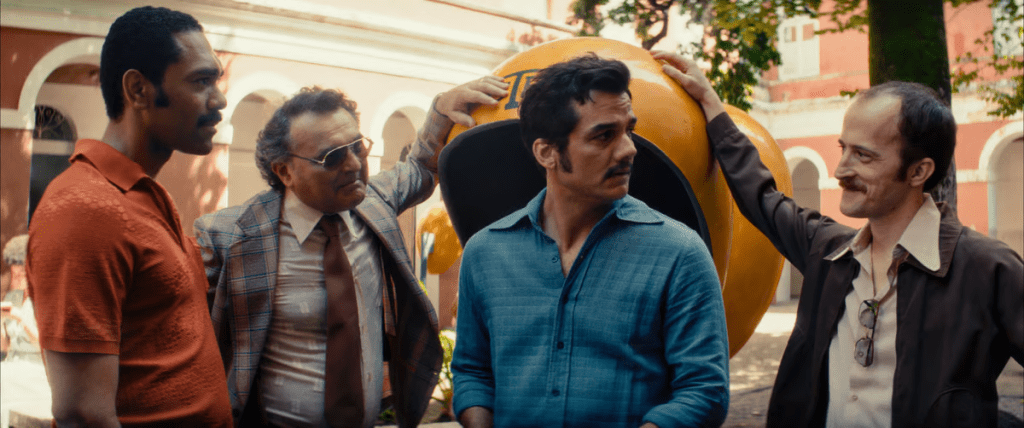
Based on where the film begins, I never would have predicted where it ultimately ends. The conclusion feels a bit unusual at first, but it grew on me the more I sat with it. There’s something quietly profound in the way the story resolves—an ending that many films attempt but few execute this effectively. It leaves viewers with a subtle sense of reassurance, a feeling that, despite everything, things might still be okay.
At 2 hours and 38 minutes, parts of the second and third acts do feel stretched. This is a thriller at its core, and while several key scenes deepen the characters and heighten the stakes, the film doesn’t always provide full payoff for some of its setups. A tighter edit—especially in the later acts—could have improved the pacing and maintained stronger momentum. Even so, the overall rhythm remains engaging enough, immersing you in the atmosphere of 1977 Brazil and keeping you invested in the journey.

Overall, it’s easy to see why The Secret Agent is being hailed as one of the year’s best films. The filmmaking is exceptional, with Kleber Mendonça Filho clearly having a deliberate purpose in the story he tells. Wagner Moura delivers another outstanding performance, reaffirming why he is one of the finest actors working today and positioning him well for awards recognition. While the pacing could have been tighter in places, the film remains a thrilling, thematically rich experience that keeps viewers engaged from beginning to end.
VERDICT: 4.5/5 – Amazing



 The Creative Cinematic Collection
You must be logged in to post a comment.